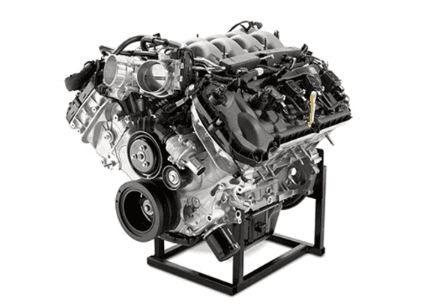
The Ford 5.0L V-8 Coyote engine offers unmatched performance and reliability, making it a prime pick for automotive enthusiasts. Its name pays tribute to Ford’s first four-valve V-8 race car, also called the Coyote. Driven by A.J. Foyt, the original Coyote amassed 25 wins, including two Indy 500 victories — an apt namesake for the modular engine that would redefine Ford’s performance and capability.
The 5.0L Coyote engine features a dual overhead cam design and a signature V configuration that defines this Ford powerplant’s architecture. It features an aluminum cylinder block and head. Performance specifications vary by generation and vehicle installation, but you can get anywhere from 360 to 500 hp, with torque between 380 and 420 lb-ft, depending on the build.
Since its debut in 2011, the Ford Coyote engine has been a key member of the Ford Modular family, undergoing several revisions through its latest update in 2024. Each of the four Coyote generations has had its own set of strengths.
When the Ford Coyote engine was first developed, it was designed to fit within the same physical footprint as the outgoing 4.6L V-8 it was replacing. Intended as a key competitor for GM’s 6.2L LS3 and Chrysler’s 6.4L HEMI, the original Coyote engine gave Ford an edge over rivals such as the Chevrolet Camaro and Dodge Challenger.
The Gen 1 Coyote engine benefited from Ford’s first use of twin independent variable camshaft timing (Ti-VCT) technology. This tech utilizes electrically-controlled hydraulic valves to direct engine oil to the camshaft phaser cavity, regulating oil flow through the valve spools for optimal operation. The system simultaneously limits fuel consumption while maximizing power and torque. This enhances performance, improves fuel efficiency, and reduces emissions.
The result of Ford’s innovative implementations was an engine that delivered power on par with its competitors despite being more compact in size. The Coyote marked Ford’s reentry into the 5.0L segment for the first time in 15 years. Running on regular 87-octane unleaded gasoline, it offered a convenient choice for drivers who wanted unparalleled performance without premium fuel requirements.
In 2015, Ford introduced the second-generation Coyote engine, developed specifically for the redesigned Mustang. This version featured Ti-VCT tuning and the addition of charge motion control valves. It also included larger intake and exhaust valves along with increased camshaft lift.
Introduced in 2018 for the updated Mustang, the third-generation Coyote engine was lighter than its predecessors and packed with performance upgrades. It featured a 12:1 compression ratio and high-pressure direct injection. A plasma transferred wire arc replaced the previous steel sleeves. The Gen 3 Coyote was bigger all around with a larger cylinder bore, valves, and cam lobes.
The Gen 4 Coyote was unveiled with the sixth-generation 2024 Mustang GT. This most recent iteration of the Coyote engine has dual throttle bodies, enhanced engine cooling, and an updated intake manifold. In the Mustang Dark Horse, this engine is further reinforced with stronger connecting rods and revised camshafts.
The Coyote engine has been featured in numerous Ford vehicles, offering impressive performance with every installation. You can experience this V-8 engine in the following models:
The Coyote is available as a crate engine, making it a popular pick for restorations and custom builds. Classic car enthusiasts appreciate the Coyote’s compact size and impressive power. With fewer components than a turbocharged V-6, the Coyote engine presents a lower chance of failure. It delivers big performance in a reliable, straightforward package.
In 2017, Velocity Restorations made waves by swapping a 5.0L V-8 Coyote engine into a Ford Bronco restomod, setting a trend that would influence years of similar builds. The Gen 3 Coyote became the exclusive engine choice for all of Velocity’s Ford-based vehicles, including additional Bronco projects, Mustang builds, and F-Series trucks. If you’re working on a restomod, a Ford Coyote crate engine is a great choice.
The Coyote engine has numerous advantages. It features a relatively simple build with superior durability and an impressive life span. Its reliable timing chains, forged connecting rods, and forged crankshaft are all built to last. The first- and second-generation models include iron cylinder sleeves that can be machined or replaced.
In the Gen 3 and Gen 4 models, the cylinder walls can’t be machined due to the introduction of spray-on bore liners. Direct fuel injection rolled out with the Gen 3 Coyote as well, adding a bit more complexity to the engine’s design. The biggest drawback of the Coyote is its fuel consumption, so if you prioritize fuel economy, you may want to select Ford’s EcoBoost engines.
If you want to feel the power of the Ford Coyote engine for yourself, come to Planet Ford Dallas. We can set you up for a test-drive in a Ford Mustang or Ford F-150 featuring this iconic engine.
Experience the 5.0 Coyote engine firsthand in Dallas, Texas, now. We can help you add a vehicle with this powerful engine to your garage today.